WINCHESTER’S ST. CROSS
St. Swithun, who died more than one thousand years ago, in A.D. 862, was the Bishop of Winchester. When his remains were moved, against his dying wishes, from their final resting place in a simple tomb in the cathedral grounds to a splendid shrine in the inner sanctum, it proceeded to rain heavily for 40 days, which was seen as a sign of his displeasure.
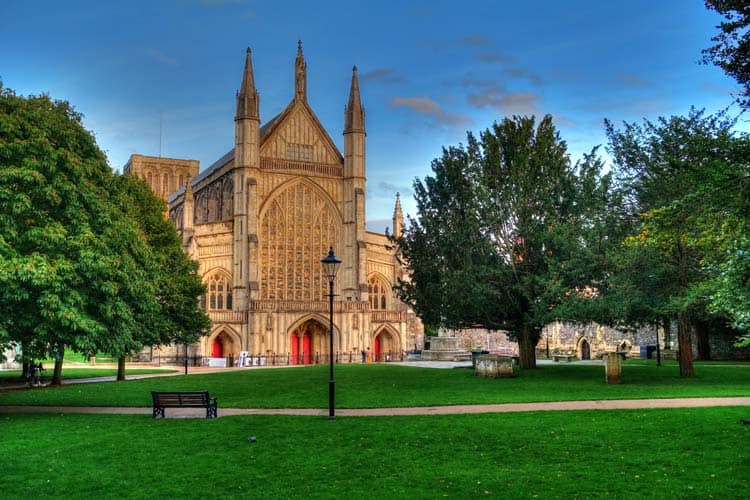
Winchester Cathedral
There wasn’t a raindrop to be seen, only clear-blue, cloudless skies, when I visited Winchester.
Accompanied by a cacophony of birdsong, I walked alongside the River Itchen through meadows to the medieval almshouse, Hospital of St. Cross, which rather quaintly offers travelers the “Wayfarers’ Dole” — a small beaker of beer and morsel of bread — as it has done for more than eight centuries.
The hospital was founded to support 13 poor, frail men who were unable to work, and to feed 100 men at the gates each day. The 13 men became the Brothers of St. Cross. Then, as now, they were not monks.
Medieval St. Cross was endowed with land, mills and farms, providing food and drink for a large number of people — but in those days the water was unfit for drinking, so copious amounts of ale and beer were needed.
The hospital has continued to provide sheltered accommodation for older gentlemen since its foundation in 1136, and one of them was happy to explain how England’s ancient capital is steeped in history, offering rich pickings for visitors looking to uncover Britain’s past. This treasure trove of English heritage is packed with historic buildings, monuments and museums all waiting to be explored.
City Character
Winchester’s character and layout have been dominated by the church, state, law and military throughout history. As visitors walk around the compact city center, they move from one quarter to another, each influenced by the impressive buildings that still embody these institutions.
For first-time visitors, it makes sense to get your bearings by going on one of the local walks. Keats’ Walk provided the poet with inspiration and who knows, may do the same for you, while the Winchester Walk allows you to explore some of the many attractions in King Alfred’s city.
(King Alfred the Great, 849–899, fought against the invasion of Vikings in southern England, and eventually signed a peace treaty with them.)
Another excellent way to become acquainted with Winchester is to join a guided tour with the Blue Badge Tourist Guides. Their love of history, sense of humor and passion for their city is contagious, encouraging visitors to return time after time. Tours take place throughout the year.
The Cathedral Refectory
First on my must-see list was that place of worship for more than 900 years, Winchester’s world-famous cathedral, where entry is by donation. This building is as remarkable for its hidden treasures as it is for its spectacular architecture.
Here, in the longest medieval nave in Europe, outstanding works of art vie for attention alongside the tombs of Jane Austen, Izaak Walton and the early English kings.
The Winchester Bible is recognized as the finest of all the great 12th-century bibles, due to its size and sumptuous illumination. The Sound II statue by Antony Gormley, installed in 1986, stands in the evocative setting of the crypt.
The carved, black-marble 12th-century font was probably used to baptize the future King Henry III, in 1207. Romanesque in style, two sides portray scenes from the life of St. Nicholas of Myra, better known as Santa Claus.
The Cathedral Refectory is in the walled garden opposite the west window. This tranquil setting is a great place to enjoy simple meals. Themed events often take place here too, including Scottish evenings with plenty of tartan and rousing pipe tunes. The food here is made from local ingredients.
Food & Drink in Winchester
In fact, an increasing number of Winchester eateries cook with local produce. The rivers are famed for their trout, which thrive in the clear, fast-running waters, while acres of watercress flourish in the Itchen and Meon valleys.
The Wykeham Arms, on Kingsgate Street, near Winchester College, is a fabulous old pub just bursting with history. The tables are ancient desks from the college, complete with old-fashioned inkwells.
Winchester is also home to the original Hotel du Vin & Bistro, housed in one of the city’s most important Georgian buildings, dating back to 1715.
Folklore and Fun in Winchester
Winchester features a tempting array of independent shops, boutiques and antiquarian bookshops. The pedestrian High Street, once the Romans’ east-to-west route through the city, is home to bow-fronted Regency and Elizabethan shops.
The Lloyds Bank building, formerly the Guildhall, is where the 8 p.m. nightly curfew still rings out, as it has done for hundreds of years.
Stroll through tranquil streets and leafy courtyards alongside the sparkling waters of the River Itchen and you will come to the 13th-century Great Hall, with its richly stained-glass windows — the only part of Winchester Castle that still survives today.
The Round Table, associated with legendary King Arthur and his Knights, has been situated here for more than 600 years.
Before returning home, I paid a visit to the oldest continuously running school in the country, the bewitchingly grand Winchester College.
Winchester is surely the heartbeat of England, with sights that will fill your senses — but a word of warning, one visit won’t be enough. You’ll want to come back.